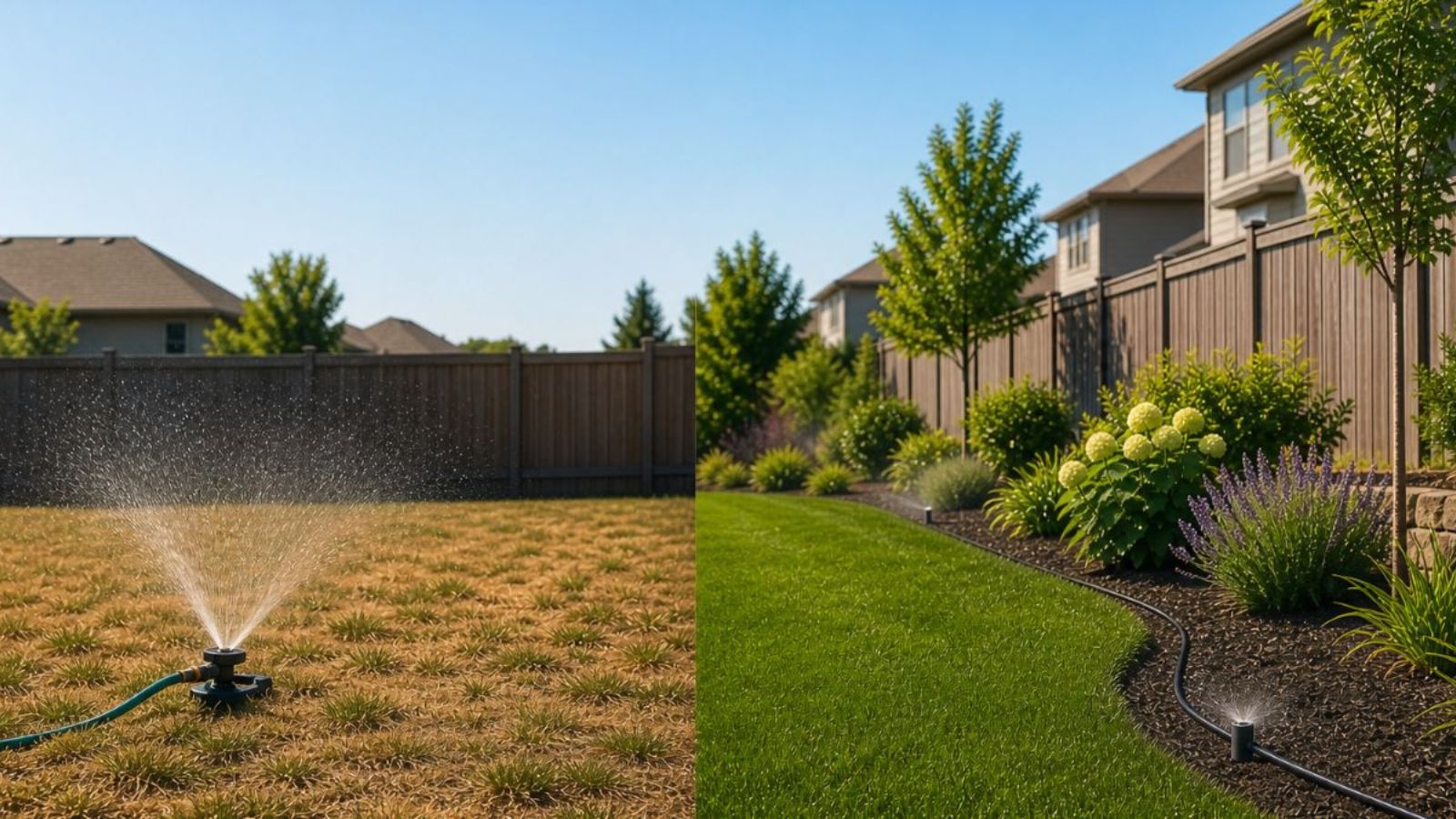
During the first long stretch of summer heat, we start getting a very familiar pattern of calls. Systems that tested fine in spring suddenly show uneven watering, dry patches, or zones that don’t look as consistent as others.
What’s notable in most summer sprinkler problems is that the system is still technically running. The issue is usually how evenly water is being delivered once evaporation increases and turf stops recovering quickly between cycles.
Most of what we find in the field is not failure but drift. Small changes in alignment, flow, or programming that only become visible under heat stress.
Why Summer Heat Exposes Issues
Summer conditions don’t create sprinkler problems. They reveal them.
In spring, lawns can “mask” uneven watering because moisture stays in the soil longer. Once temperatures rise, that buffer disappears quickly.
Common conditions that make issues more visible:
- Faster soil drying between cycles
- Higher evaporation during daytime runs
- Longer recovery time for stressed turf
- Existing coverage gaps becoming noticeable
One thing we often hear from homeowners is that “nothing changed.” In reality, the system didn’t change; the conditions did.
Sprinkler Head Drift Issues
A large share of summer service calls start with uneven green and brown patterns that follow arcs or strips.
In the field, this is usually caused by sprinkler heads that have shifted slightly over time.
What we typically find:
- Heads rotated a few degrees from mowing contact
- Spray arcs no longer overlapping properly
- One edge of a zone consistently drying first
A key detail is how subtle the movement is. It often doesn’t look wrong while the system is running. What can be seen is the lawn response after several cycles.
Most of the time, the fix is not a replacement. It’s realignment and checking overlap rather than changing hardware.
Nozzle Clogging Issues
Another common summer sprinkler problem call involves heads that run but don’t perform evenly.
We often see this after spring startup when debris moves through the system.
Typical symptoms:
- One head is misting while others spray normally
- Reduced throw distance in part of a zone
- Inconsistent spray pattern within the same run
What’s important here is that customers often assume pressure loss. In many cases, it’s actually a partial restriction at the nozzle or filter screen.
A pattern we’ve seen repeatedly is that the system looks fine at startup, then gradually loses consistency as debris settles over time.
Controller Schedule Drift
Not all sprinkler issues are mechanical. A significant number we see are programming-related.
Controllers often get adjusted multiple times in spring, then left alone through summer.
What we commonly find on site:
- Overlapping programs still active
- Rain delays are not fully cleared
- Zones running longer or shorter than intended
- Different schedules stacked unintentionally
The issue is not obvious from the screen alone. You have to trace how programs interact, not just what time they’re set to.
In many cases, resetting to a clean seasonal schedule resolves more than trying to adjust individual settings.
Hidden Underground Leaks
Some of the more difficult summer sprinkler problems are underground issues that don’t show immediately.
These leaks don’t always create visible pooling. Instead, we usually see:
- Gradual drop in spray distance across a zone
- Weak coverage despite normal runtime
- One section consistently underperforms
A common misconception is that more watering fixes it. In reality, water is being lost before it reaches the surface.
In the field, these often trace back to:
- Small cracked fittings
- Loose connections from soil movement
- Root pressure shifting joints over time
Pressure testing is usually required to confirm what’s happening underground.
Lawn Maintenance Damage
A surprising number of sprinkler issues come from routine yard work rather than system failure.
We frequently see heads affected by repeated contact over time.
Common findings:
- Heads slowly pushed below grade from mowing
- Spray direction altered by edging tools
- Broken or tilted risers still “functioning” but misdirected
What makes this tricky is that the system still appears operational. Water is coming out but not landing where it should.
These issues usually build slowly enough that they go unnoticed until dry patterns become obvious in the lawn.
Keeping Systems Reliable
Most summer sprinkler problems are not sudden breakdowns. They are small shifts in alignment, debris buildup, scheduling drift, or underground changes that only become visible under heat stress.
In most cases we service, the system itself is still functional. What changes is how accurately it is delivering water compared to what the lawn now requires.
When small issues are caught early, performance usually stabilizes quickly. When they’re missed, they tend to show up as recurring dry spots throughout the season.
Frequently Asked Questions
Why is my sprinkler system running, but my lawn is still dry?
This usually happens when coverage is uneven due to shifted heads, partial clogging, or reduced overlap between zones. The system may be running normally, but water is not reaching all areas effectively.
What causes sprinkler heads to perform poorly in summer?
Heat exposes existing issues like debris buildup, slight head movement, or weak overlap between spray patterns. These problems often exist before summer but only become visible under stress conditions.
How do I know if I have a hidden sprinkler leak?
A gradual loss of spray distance in one zone is a common early sign. If runtime hasn’t changed but performance keeps dropping, underground loss is likely.
Why do sprinkler schedules stop matching lawn needs?
Multiple spring adjustments often stack without being fully reset. Over time, this creates overlapping or conflicting programs that don’t reflect current conditions.
Can mowing affect sprinkler systems?
Yes, repeated mowing and edging can slowly shift or damage sprinkler heads. Even small changes in height or angle can affect spray direction over time.
Pioneer Underground Lawn Sprinklers | Sprinkler System Repairs and Maintenance Omaha, NE
Contact Pioneer Underground Lawn Sprinklers to schedule a free estimate on a system install or to find out what you can do to make your existing system more efficient. We welcome commercial and residential clients. And remember, whether you need our services now… or later in the season, Your Healthy Lawn is Our Passion, and we are only a phone call away.